
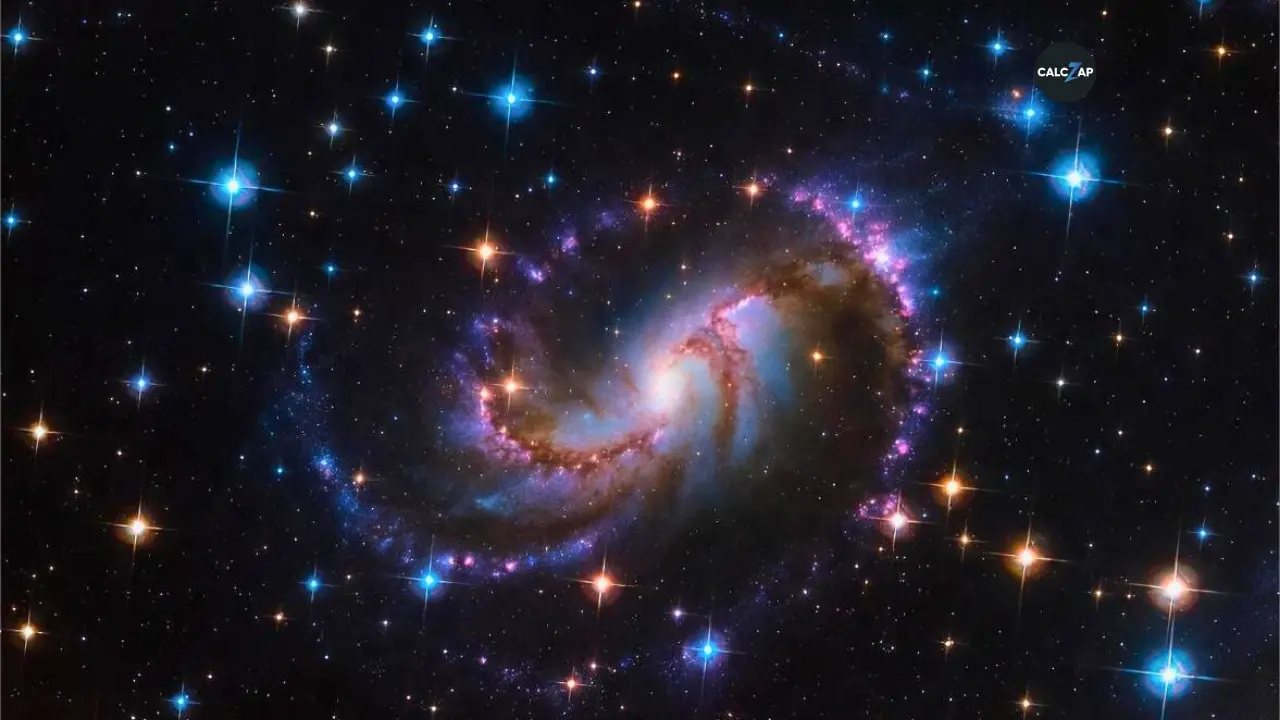

Have you ever pondered, “Wait how gravity actually works in space if they’re weightless?” while observing astronauts floating within the International Space station you’re not by yourself. Most people believe that after you leave Earth, gravity just disappears. It doesn’t spoiler alert. Let’s finally dispel the misconception in plain English using actual science, a little comedy, and no false information.
Gravity Never Stops — It Only Gets Weaker With Distance
The unseen glue of the cosmos is gravity. Every item with mass attracts every other object, according to Newton law of universal gravitation. which was subsequently validated by Einstein general relativity. The strength never reaches zero, although it decreases with the square of the distance.
At sea level on Earth, your weight causes you to accelerate toward the core of the globe at a speed of around 9.8 m/s². Gravity is still around 90% of what it is on Earth at the ISS altitude of 400 kilometers or 250 miles. Indeed, 90%. This figure is confirmed by both NASA and ESA. What makes astronauts float then?
The Real Reason Astronauts Float: They’re in Constant Free Fall?
The International Space Station is orbiting the Earth at 17,500 mph (28,000 km/h) not outside of gravity. Everything within the station is dropping at precisely the same rate. You feel weightless when everything comes together.
Imagine leaping off a diving board inside a plummeting elevator. Like Chris Hadfield floating in space with a guitar, you would float inside the elevator as it plummets. That is not zero gravity but orbital free fall.
Since there are still minute forces like air drag, solar radiation pressure and even astronauts pushing off walls. NASA refers to the ISS environment as microgravity rather than zero gravity.
Gravity Keeps the Moon, Planets, and Even Galaxies Together
The same force that causes you to drop your phone also maintains Earth’s orbit around the Sun and the Moon’s orbit around Earth at a speed of around 2.38 mm/s². Even black holes? Gravity is still present, but it is incredibly powerful due to the large amount of mass crammed into a small area. we would crash directly into the Sun in around 65 days if Earth abruptly ceased rotating and circling. Fortunately, gravity is dependable.
Do You Weigh Less on the Moon or in Space?
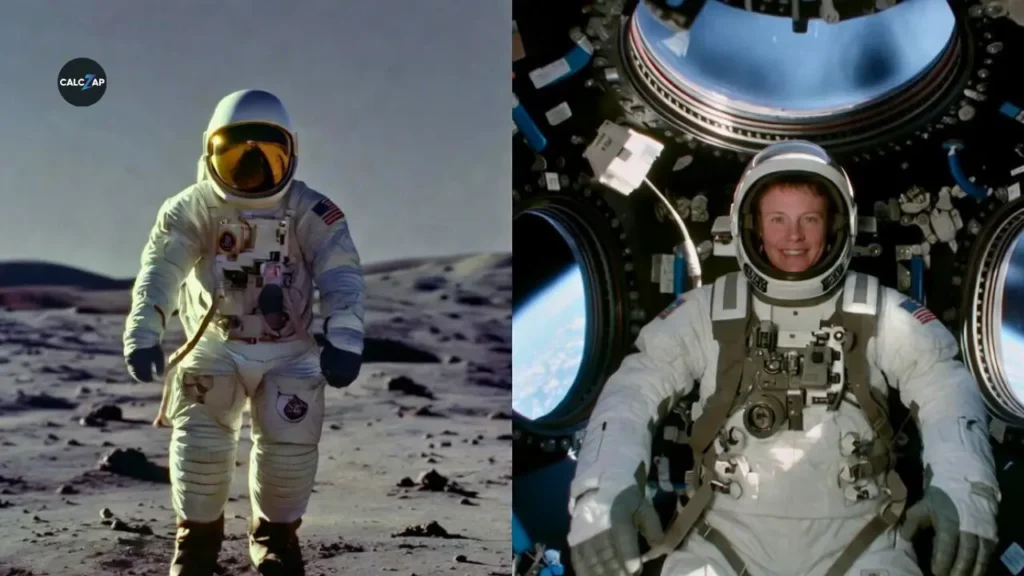
On the moon, your weight is approximately one-sixth that of Earth (gravity = 1.62 m/s². You still weigh about 90% of what you would on Earth when in low Earth orbit (ISS), but you are constantly in free fall and don’t realize it. In other words, although you technically weigh heavier in space than on the Moon, you can only experience the weight reduction on the Moon.
Deep Space Gravity: It’s Still There, Just Minimal?
Gravity never completely vanishes, not even between galaxies. Even though it is extremely weak, the Sun’s gravity is nevertheless detectable at the solar system’s outermost point, which is around 100,000 AU distant. Even at a distance of more than 15 billion miles, Voyager 1 is still somewhat pulled by the Sun’s gravitational pull.
Quick Recap: How Gravity Actually Works in Space
- NASA – What Is Microgravity (nasa.gov)
- European Space Agency Gravity in Orbit (esa.int)
- NOAA/NASA/USAF – U.S. Standard Atmosphere 1976 (gravity calculations)
- Einstein, A. (1915) – General Theory of Relativity (the modern explanation of gravity)
You may smile and share this information the next time someone says, There’s no gravity in space. Even when it appears to be on vacation, gravity is always at work.
Have additional inquiries about space. We enjoy discussing rockets, black holes and the reasons why things don’t just blow up! Please leave them below!
Sources:
- In the cosmos, gravity is present everywhere.
- Distance makes it weaker, but it never reaches zero.
- Because of their constant free fall around the Earth (microgravity), astronauts are able to float.
- Scientists like microgravity; the term “zero gravity” is a fallacy.